

History of the Names
𐤉𐤄𐤅𐤄

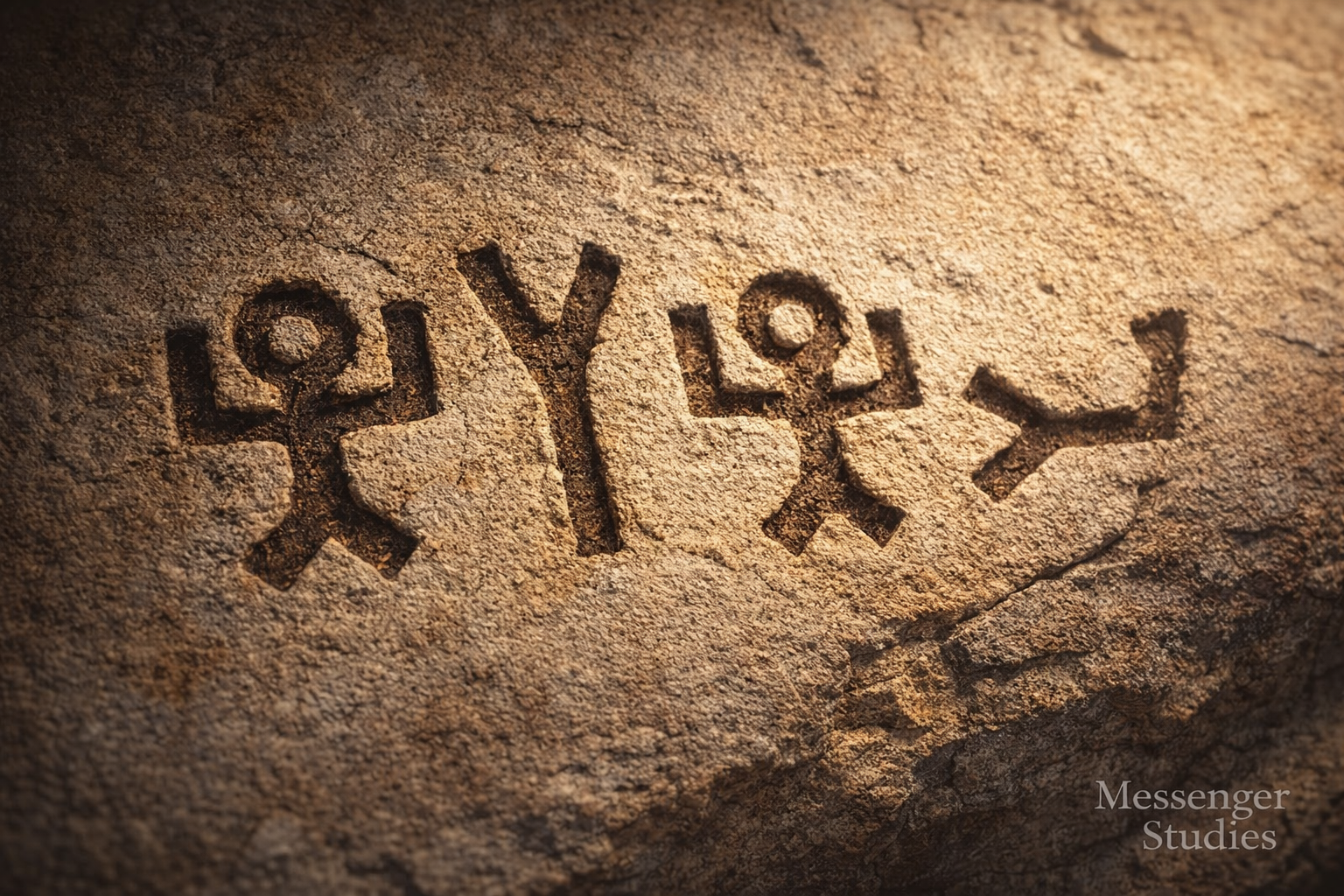

For many families, learning the Scriptures together begins with simple questions: Who is our Creator? What is His Name? How can we draw closer to Him? As we open the Bible, we discover that our Heavenly Father did not hide His Name—He shared it with His people as a gift, a promise, and an invitation into relationship. Throughout Scripture, this Name appears thousands of times, reminding us that He is not distant or unknown, but near to those who call upon Him.
As you explore this page, you’ll see how history, archaeology, and the Bible all point to the same truth: the Name of our Father has been known and cherished since ancient times. Families just like yours—across generations and nations—have spoken it in worship, taught it to their children, and trusted in the One who bears it. Our hope is that this journey strengthens your home, deepens your faith, and helps you know the One who said, “This is My Name forever, and this is My remembrance to all generations.”
The History of the Divine Name YHWH (Yahweh)
- TheTetragrammaton in the Hebrew Bible
The personal name of the God of Israel appears in the Hebrew Scriptures as the Tetragrammaton—the four consonants YHWH (יהוה). This form, consisting of Yod–Heh–Waw–Heh, is universally recognized in biblical scholarship as the proper name of Israel’s deity. Britannica
Early Christian writers such as Clement of Alexandria (2nd century CE) preserved a pronunciation close to Yahweh, and Greek transcriptions from antiquity also support this vocalization. Britannica
- Why “Yahweh” Is the Scholarly Pronunciation
Modern biblical scholarship overwhelmingly identifies Yahweh as the most accurate reconstruction of the ancient pronunciation. This conclusion is based on:
- Early Greek transliterations reflecting a Ya‑hweh sound
- Patristic testimony (e.g., Clement of Alexandria)
- Comparative Semitic linguistics
- Internal Hebrew morphology
The form “Jehovah” is not ancient. It arose in the Middle Ages when Christian scholars mistakenly combined the consonants YHWH with the Masoretic vowels of Adonai (“my Lord”), producing an artificial hybrid never used in ancient Israel. Britannica
- The Shift Away from Pronouncing the Name
After the Babylonian Exile (6th century BCE), Jewish practice gradually moved away from vocalizing the Name. Two major developments shaped this shift:
- Judaism’s universalization—as the faith expanded beyond ethnic Israel, the more general title Elohim (“God”) became preferred to emphasize universal sovereignty.
- Growing reverence—the Name came to be regarded as too sacred to pronounce, leading readers to substitute Adonai (“my Lord”) during synagogue readings.
This substitution was carried into the Septuagint, where translators rendered YHWH as Kyrios (“Lord”). Britannica
- The Masoretic Tradition and the Origin of “Jehovah”
Between the 6th and 10th centuries CE, the Masoretes added vowel points to the consonantal Hebrew text. When marking the Tetragrammaton, they inserted the vowels of Adonai (or occasionally Elohim) to signal that the reader should not pronounce the Name but instead say “Adonai.”
Later Latin‑speaking Christian scholars misread this cue, replacing the Hebrew Y with Latin I/J, producing the hybrid form Jehovah. This form spread through medieval Europe but is now recognized as linguistically incorrect. Britannica
- The Meaning of the Name
The meaning of YHWH has been debated, but many scholars connect it to the verbal root hwy/hyh, relating to existence or being. A common scholarly interpretation is “He brings into being” or “He causes to be.” Britannica
Austin Surls’ analysis of Exodus 3:13–15 and 6:2–8 demonstrates that the theological meaning of the Name is revealed progressively in the narrative, culminating in the proclamation of divine character in Exodus 34:6–7. Project MUSE
- Archaeological and Historical Background
Archaeological and historical research has expanded our understanding of the Name’s early usage. Daniel E. Fleming’s Yahweh Before Israel (2020) argues that references to “Yhw” in Egyptian records—particularly among the Shasu peoples—suggest that the Name was known in the southern Levant before Israel’s emergence as a nation. Google Books
This evidence supports the view that the worship of Yahweh has deep roots in the ancient Near East and was not merely borrowed from neighboring cultures but reflects the diverse origins of early Israelite identity. Google Books
- The Name in Later Jewish and Christian Tradition
By the early centuries CE, the avoidance of pronouncing the Name was firmly established in Jewish practice. The tradition of substituting Adonai continued into Christian usage through the Septuagint and later translations.
During the Renaissance and Reformation, Christian scholars revived interest in the original pronunciation, and by the 19th–20th centuries, Yahweh again became the standard form in academic literature. Britannica
- Summary
- YHWH is the ancient personal name of Israel’s God.
- Yahweh is the historically and linguistically supported pronunciation.
- Jehovah is a medieval hybrid created through a misunderstanding of Masoretic notation.
- Jewish avoidance of pronouncing the Name shaped later translations and liturgical traditions.
- Archaeological and linguistic evidence confirms the antiquity and significance of the Name in the ancient Near East.
The Timeline of the Use
Timeline of the Divine Name YHWH (Yahweh)
A historical overview from earliest evidence to modern scholarship
1400–1200 BCE — Early References to “Yhw” in Egyptian Texts
Egyptian inscriptions referencing the Shasu of Yhw indicate that a deity named Yahweh was known in the southern Levant before Israel’s emergence as a nation.¹
These inscriptions appear in temple records from Soleb and Amarah West, linking Yahweh’s worship to regions south of Canaan.
1200–1000 BCE — The Tetragrammaton in Early Israel
The Name YHWH becomes central to Israelite identity.
Early biblical poetry (Exodus 15; Judges 5) reflects Yahweh as Israel’s national deity, celebrated as deliverer and warrior.²
9th Century BCE — The Mesha Stele (Moabite Stone)
The Moabite king Mesha records conflict with Israel and explicitly names YHWH as Israel’s God.³
This inscription provides one of the earliest extra‑biblical confirmations of the Divine Name.
6th Century BCE — Post‑Exilic Shift Away from Pronouncing the Name
After the Babylonian Exile, Jewish tradition increasingly avoids vocalizing the Name.
Readers substitute Adonai (“my Lord”) when encountering YHWH in Scripture, marking the beginning of reverential avoidance.⁴
3rd–2nd Century BCE — The Septuagint (LXX)
Greek translators replace YHWH with Kyrios (“Lord”), cementing the substitution in Jewish and later Christian tradition.⁵
This translation choice profoundly shaped Western liturgical language.
1st–2nd Century CE — Early Christian Witnesses
Writers such as Clement of Alexandria preserve a pronunciation close to Yahweh, supporting modern scholarly reconstruction.⁶
Clement’s Stromata (Book V) records the form Iaoue, echoing the Hebrew vocalization.
6th–10th Century CE — Masoretic Vowel Pointing
Masoretic scribes added the vowels of Adonai to YHWH to signal readers to say “Adonai” instead of pronouncing the Name.
This notation later led to the hybrid form Jehovah.⁷
13th–16th Century CE — Emergence of “Jehovah”
Christian scholars misread the Masoretic vowel cues, producing the artificial form Jehovah, which spread through Europe via Latinized texts and early English Bibles.⁸
19th–20th Century CE — Modern Scholarship Reaffirms “Yahweh”
Linguistic, archaeological, and textual studies converge on Yahweh as the most accurate ancient pronunciation.⁹
Scholars such as Frank Moore Cross and William Albright confirm its linguistic roots in the Hebrew verb hayah (“to be”).
2008 — Vatican Directive on the Name
The Vatican instructs Catholic liturgy to avoid pronouncing “Yahweh,” continuing the tradition of substitution with “Lord.”¹⁰
This directive reaffirms reverence for the ineffable Name in worship contexts.
Present Day — Restoration and Scholarship
Academic consensus, archaeological evidence, and linguistic analysis affirm the antiquity and accuracy of the pronunciation Yahweh.
Many study groups, translators, and ministries—including Messenger Studies—restore the Name to its original place in Scripture.¹¹
Footnotes
- Daniel E. Fleming, Yahweh Before Israel (Cambridge University Press, 2020).
- Frank Moore Cross, Canaanite Myth and Hebrew Epic (Harvard University Press, 1973).
- André Lemaire, “The Mesha Stele and the Omri Dynasty,” Journal for the Study of the Old Testament; J. Andrew Dearman, Studies in the Mesha Inscription (Scholars Press, 1989).
- William G. Dever, Did God Have a Wife? (Eerdmans, 2005).
- Emanuel Tov, Textual Criticism of the Hebrew Bible (Fortress Press, 2012).
- Clement of Alexandria, Stromata, Book V.
- Smith’s Bible Dictionary (1869), s.v. “Jehovah.”
- Jeffrey Tigay, You Shall Have No Other Gods (Scholars Press, 1986).
- Cross, Canaanite Myth and Hebrew Epic; Albright, From the Stone Age to Christianity (1940).
- Congregation for Divine Worship and the Discipline of the Sacraments, Directive on the Use of the Divine Name (2008).
- Contemporary restoration movements and linguistic studies summarized in Fleming (2020) and Dever (2005).
Historical and Archeological Evidence
Historical and Archaeological Evidence for the Divine Name YHWH (Yahweh)
- Introduction
The Divine Name YHWH (יהוה), commonly vocalized as Yahweh, is the most frequently occurring name for the God of Israel in the Hebrew Bible. Its antiquity is supported by textual, linguistic, and archaeological evidence spanning more than three millennia.¹
- Earliest Extra‑Biblical References to Yahweh
2.1 Egyptian Inscriptions: “The Shasu of Yhw” (c. 1400–1200 BCE)
Egyptian New Kingdom inscriptions from the reigns of Amenhotep III and Ramesses II refer to a group called the Shasu of Yhw, widely recognized as an early reference to Yahweh or a Yahweh‑associated region.²
These inscriptions place Yahweh worship in the southern Levant before Israel’s emergence as a nation, aligning with biblical traditions locating Yahweh’s early manifestations in Seir, Edom, Paran, and Teman (Deut. 33:2; Judg. 5:4; Hab. 3:3).
2.2 The Mesha Stele (Moabite Stone, 9th Century BCE)
The Mesha Stele, discovered in 1868 at Dibon, contains the earliest monumental inscription explicitly naming YHWH as the God of Israel.³
It corroborates the biblical account of Moab–Israel conflict (2 Kings 3) and demonstrates that Yahweh was recognized by Israel’s neighbors.
- The Name YHWH in Ancient Israel
3.1 Hebrew Inscriptions Containing the Name
Several Iron Age inscriptions contain the Name YHWH, including:
- The Kuntillet ‘Ajrud inscriptions (c. 800 BCE)
- The Khirbet el‑Qom inscription (c. 700 BCE)
- The Ketef Hinnom silver amulets (7th century BCE)
These inscriptions show that the Name was used in daily religious life, not only in Scripture.
The Ketef Hinnom amulets contain the oldest biblical text ever discovered, invoking YHWH in the priestly blessing (Num. 6:24–26).⁴
- Linguistic and Textual Evidence
4.1 Meaning of the Name
Most scholars connect YHWH to the Hebrew root HYH/HWY (“to be, to exist”).
This aligns with Exodus 3:14–15, where God reveals Himself as Ehyeh asher ehyeh — “I Am That I Am” or “I Am the Existing One.”
Linguistic parallels include Amorite names containing yahwi‑ (“he exists”) and Akkadian expressions of divine existence.⁵
4.2 Early Greek Transliterations
Greek writers such as Clement of Alexandria (2nd century CE) preserve forms like Iaoue, closely matching Yahweh.
These transliterations predate medieval vowel confusion and reflect how Jews of the Second Temple period understood the Name.⁶
- The Masoretic Shift and the Rise of “Jehovah”
5.1 Masoretic Vowel Substitution (6th–10th Century CE)
Masoretic scribes added the vowels of Adonai to YHWH to signal that readers should not pronounce the Name.
Medieval Christian scholars misread this notation, producing the hybrid form Jehovah.
Scholarly consensus holds that “Jehovah” is a late hybrid, not the ancient pronunciation.⁷
- Archaeology Confirms the Antiquity of Yahweh Worship
6.1 Yahweh in the Southern Levant
Archaeological evidence places Yahweh’s earliest worship in Edom, Seir, Midian, and the Negev, aligning with biblical theophany traditions (Deut. 33:2; Judg. 5:4; Hab. 3:3).⁸
6.2 Yahweh and Israelite Identity
Material culture—including inscriptions, seals, and ostraca—shows that:
- Yahweh was the central deity of Israel from its earliest formation.
- His Name appears in theophoric names (e.g., Yesha‑yahu, Yirmeyahu).
- The Name was used publicly, liturgically, and devotionally.⁹
- Summary
Archaeology, linguistics, and textual history converge on the conclusion that:
- YHWH is the ancient personal name of Israel’s God.
- Yahweh is the historically supported pronunciation.
- The Name is deeply rooted in the earliest layers of Israelite religion.
- Extra‑biblical inscriptions confirm the Name’s antiquity and widespread recognition.
- Later traditions obscured the pronunciation, but the historical evidence remains clear.
Footnotes
- Frank Moore Cross, Canaanite Myth and Hebrew Epic (Harvard University Press, 1973); Daniel E. Fleming, Yahweh Before Israel (Cambridge University Press, 2020).
- K. A. Kitchen, On the Reliability of the Old Testament (Eerdmans, 2003), 279–284; Fleming, Yahweh Before Israel, 2020.
- André Lemaire, “The Mesha Stele and the Omri Dynasty,” Journal for the Study of the Old Testament; J. Andrew Dearman, Studies in the Mesha Inscription (Scholars Press, 1989).
- Gabriel Barkay et al., “The Amulets from Ketef Hinnom,” Bulletin of the American Schools of Oriental Research 334 (2004): 41–71; William G. Dever, Did God Have a Wife? (Eerdmans, 2005).
- Cross, Canaanite Myth and Hebrew Epic; Austin Surls, Making Sense of the Divine Name in Exodus (Eisenbrauns, 2017).
- Clement of Alexandria, Stromata, Book V; Emanuel Tov, Textual Criticism of the Hebrew Bible (Fortress Press, 2012).
- Smith’s Bible Dictionary (1869), s.v. “Jehovah”; Jeffrey Tigay, You Shall Have No Other Gods (Scholars Press, 1986).
- Ernst Knauf, “Yahweh in Edom,” Biblica 69 (1988): 31–44; Fleming, Yahweh Before Israel.
- Richard S. Hess, Israelite Personal Names in the Book of Joshua (Sheffield Academic Press, 1993); William G. Dever, Who Were the Early Israelites and Where Did They Come From? (Eerdmans, 2003).
Yahshua / Yeshua / Iēsous / Jesus
The Name Yahshua: Linguistic, Historical, and Theological Foundations
The question of the Messiah’s original name is not merely linguistic — it is deeply tied to biblical theology, ancient Hebrew morphology, and the scriptural theme of the Father revealing His Name to His people. Understanding how Yahshua became Yeshua, and eventually Jesus, requires tracing the development of Hebrew, Aramaic, and Greek forms across time.
- The Original Theophoric Form: “Yah‑shua” (יהושע/יהושוע)
In ancient Hebrew, names that contain the shortened form of the Divine Name Yah (יה) are called theophoric names — names that “bear” the Name of God.
Examples include:
- Yah‑shua — “Yahweh is salvation”
- Yah‑natan — “Yahweh has given”
- Yah‑shiyah — “Yahweh supports”
- Hallelu‑Yah — “Praise Yah”
The name Yahshua (יהושע) is built from:
- Yah — the shortened form of Yahweh (Psalm 68:4)
- Shua — “to save, deliver, to cry out”
Thus the name literally means:
“Yahweh is salvation” or “Yahweh saves.”
This is why the angel in Matthew 1:21 explains the Messiah’s name in terms of salvation — a direct reference to the Hebrew root yasha.
- How “Yahshua” Became “Yeshua” in Later Hebrew
By the time of the Second Temple period, Hebrew pronunciation had shifted. Theophoric names beginning with Yah‑ were often shortened to Ye‑ in everyday speech.
Examples:
- Yah‑shua → Ye‑shua
- Yah‑natan → Ye‑natan
- Yah‑ho‑natan → Ye‑ho‑natan
- Yah‑ram → Ye‑ram
This shortening is well‑documented in Hebrew linguistics and is not unusual; it reflects a broader trend of vowel reduction in late Hebrew and Aramaic.
However, the shortened form removes the explicit “Yah” — the very element that identifies the Father’s Name.
Scholars such as Frank Moore Cross and David Noel Freedman note that the “Ye‑” prefix is a later phonetic contraction, not the original theophoric form.
- From “Yeshua” to “Iēsous” (Ἰησοῦς) in Greek
When the Hebrew/Aramaic name Yeshua was transliterated into Greek, several linguistic limitations affected the result:
- Greek has no “sh” sound, so “sh” → “s”
- Greek has no “h” consonant in the middle or end of words
- Greek masculine names typically end in ‑s
Thus:
Yeshua → Iēsous (Ἰησοῦς)
This form appears in the Septuagint and the Greek New Testament.
But in the process:
- The “Yah” element disappears
- The theophoric meaning becomes obscured
- The connection to the Father’s Name is no longer visible in Greek
- From “Iēsous” to “Jesus” in English
When Greek Iēsous passed into Latin as Iesus, and later into English, the letter J (a late medieval invention) replaced the initial “I” sound.
Thus:
Iēsous → Iesus → Jesus
This form reflects linguistic evolution, not the original Hebrew meaning.
- Why the “Yah‑” Matters Theologically
- “I have come in My Father’s Name” (John 5:43)
The Messiah explicitly states:
“I have come in My Father’s Name…”
In Hebrew culture, this was not metaphorical — it was literal.
A son bearing the father’s name was a sign of authority, inheritance, and identity.
The name Yah‑shua contains the Father’s Name Yah.
The forms Yeshua and Jesus do not.
- Psalm 68:4 — “Extol Him who rides upon the clouds, by His Name Yah”
Psalm 68:4 is the only verse in the Tanakh where the shortened form Yah appears explicitly in the Masoretic text.
This form appears in:
- Hallelu‑Yah (“Praise Yah”)
- Many prophetic names
- The earliest theophoric names in Israel
The Messiah’s name originally followed this same pattern.
- Prophets Who Bore the Father’s Name
Many prophets carried the Yah‑ or ‑Yahu element:
- Yesha‑yahu (Isaiah) — “Yahweh saves”
- Yirmey‑ahu (Jeremiah) — “Yahweh exalts”
- Eliy‑ahu (Elijah) — “My God is Yahweh”
- Obad‑yah — “Servant of Yahweh”
The Messiah, the greatest prophet and redeemer, would naturally bear the fullest expression of the Father’s Name.
- The Command “Hallelu‑Yah”
The phrase Hallelu‑Yah is not a generic praise word — it is a command:
- Hallelu — “Praise!” (imperative plural)
- Yah — the Name of the Father
Every time Scripture says “Hallelu‑Yah,” it is commanding the people to praise Yahweh by Name.
This reinforces the centrality of the Name in worship.
- Scholarly Support for “Yahweh” and “Yah‑shua”
Modern scholarship overwhelmingly affirms:
- Yahweh as the ancient pronunciation of the Divine Name
- Yah as the authentic shortened form
- Yah‑shua as the original theophoric form of the Messiah’s name
Scholars work consistently shows that the “Yah‑” prefix is ancient, widespread, and theologically intentional.
Conclusion
The journey from Yahshua → Yeshua → Iēsous → Jesus reflects linguistic adaptation across cultures and centuries. But the earliest, most theologically rich form — Yahshua — preserves the explicit connection to the Father’s Name.
This aligns with:
- Psalm 68:4 (“His Name is Yah”)
- The prophetic pattern of theophoric names
- The command “Hallelu‑Yah”
- The Messiah’s own words: “I have come in My Father’s Name”
- The meaning of His mission: “Yahweh is salvation”
Restoring the original form restores the original message:
The Father Himself is the source of salvation.
Footnotes
- Martin Noth, The History of Israel (Harper & Row, 1960), pp. 217–219.
- David Noel Freedman, “The Name of the God of Moses,” Journal of Biblical Literature 79 (1960).
- Emanuel Tov, Textual Criticism of the Hebrew Bible (Fortress Press, 2012), pp. 221–223.
- Frank Moore Cross, Canaanite Myth and Hebrew Epic (Harvard University Press, 1973), pp. 60–75.
- Henry St. John Thackeray, A Grammar of the Old Testament in Greek (Cambridge University Press, 1909).
- David Crystal, The Stories of English (Penguin, 2005), pp. 195–198.
- Ze’ev Meshel & Israel Finkelstein, Kuntillet Ajrud (Horvat Teman): An Iron Age II Religious Site on the Judah–Sinai Border (Israel Exploration Society, 2012).
From Us to You
As families who love the Scriptures, we all want the same thing: to know our Father more deeply, to walk in His ways, and to teach our children what is true and life‑giving. When the Messiah walked among us, He didn’t just heal bodies — He revealed hearts (John 2:24; Matthew 9:4; Luke 9:47). And in doing so, He also revealed something precious… something many of us were never taught growing up.
In His final prayer, the Messiah spoke openly about what He had given to His disciples:
John 17:6 — “I revealed Your NAME to the men whom You gave Me…”
John 17:11 — “Holy Father, keep them in Your NAME…”
John 17:26 — “I made known Your NAME to them, and will make it known…”
For many of us, this truth was hidden in plain sight. We read these verses for years without realizing that the Messiah was emphasizing something deeply personal — the Name of the Father. Not a title, not a concept, but a Name He lovingly revealed to those who belonged to Him.
We share this not to condemn anyone, but because we ourselves once didn’t know. And when we finally saw it, it changed our homes, our prayers, and our walk with Him.
A Name That Was Hidden — and Then Revealed Again
History shows that after the Babylonian exile, the Father’s Name slowly stopped being spoken aloud. Out of reverence, and eventually out of fear, people replaced His Name with titles like Adonai (“Lord”) or Elohim (“God”).
Even today, some traditions still discourage speaking His Name.
But the Messiah came at a time when speaking the Father’s Name could cost you your life — and He revealed it anyway. He entrusted it to His disciples, knowing it had been hidden for centuries.
And just as Scripture promised, the day would come when His people would once again lift up His Name with joy:
Isaiah 12:4 — “Praise YAHWEH! Call on His NAME…”
Psalm 148:13 — “Let them praise the NAME of YAHWEH…”
Proverbs 18:10 — “The NAME of YAHWEH is a strong tower…”
Psalm 68:4 — “…by His NAME YAH…”
This is not about winning an argument. It’s about families rediscovering something beautiful and ancient — something the Messiah Himself treasured.
Why This Matters to Us as Families
When we learned that the Messiah’s own Name carries the Father’s Name — Yah‑shua, meaning “Yahweh is salvation” — it touched us deeply. It helped us see the unity between the Father and the Son in a way we had never understood before.
It also helped us understand verses like:
John 5:43 — “I have come in My Father’s NAME…”
Acts 4:12 — “There is no other NAME under heaven given among men by which we must be saved.”
This isn’t about being “right.”
It’s about honoring the One who loved us first — the One who gave us His Name as a gift.
A Gentle Word About Titles
Many of us grew up using the word “God” without ever questioning it. We meant well. We were sincere. And our Father saw our hearts.
But as we studied, we learned that the word “god” is not a name — it’s a title. And in Scripture, titles were often used for many different deities. In fact, Isaiah 65:11 mentions a deity of fortune named Gad (pronounced “Gawd”), a name that sounds very similar to the English word “God.”
We don’t share this to frighten anyone or accuse anyone of wrongdoing.
We share it because we didn’t know either, and once we learned, we wanted to honor the Father in every way we could — including with our words.
A Call Back to the Father’s Heart
The Scriptures encourage us:
Exodus 23:13 — “Make no mention of the names of other mighty ones…”
Psalm 118:26 — “Blessed is he who comes in the NAME of YAHWEH.”
Psalm 150:6 — “Let everything that has breath praise Yah. Hallelu‑Yah!”
We believe we are living in the time when the Father is restoring His Name to His people — not through force, but through love. Not through debate, but through revelation. Not through pride, but through humility.
We are simply a family who discovered something precious, and we want to share it with other families who love the Father and desire to walk in His truth.
If this is new to you, take your time. Pray. Study. Ask the Father to guide you.
He reveals His Name to those who seek Him with a sincere heart.
Shalom to you and your home,
From our family to yours —
Don and Cassi Butler
Comments
Add comment