

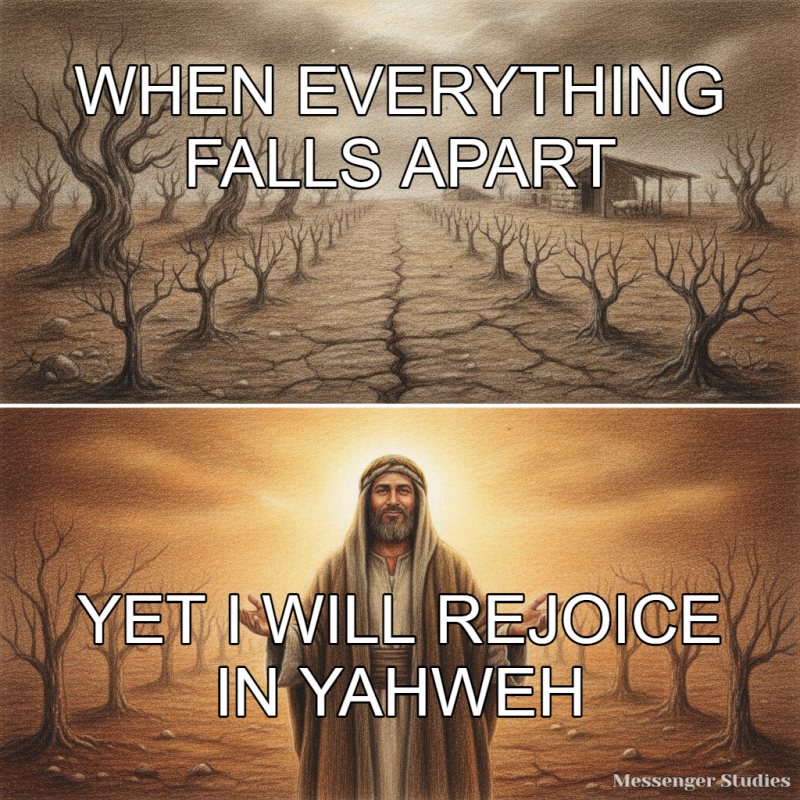
"Though the fig tree may not blossom, nor fruit be on the vines; though the labor of the olive may fail, and the fields yield no food; though the flock may be cut off from the fold, and there be no herd in the stalls – yet I will exult in Yahweh, I will rejoice in the Elohim of my salvation." – Habakkuk 3:17-18
The prophet Habakkuk painted a bleak picture of his time – a world on the brink of economic and agricultural ruin. Imagine the despair as the very sources of life and sustenance withered: no figs, no grapes, no olives, barren fields, empty sheepfolds, and silent cattle stalls. In such a scenario, the human heart would naturally sink into fear, anxiety, and desperation. Yet, in the face of this utter desolation, Habakkuk declared something profoundly counter-intuitive: "Yet I will exult in Yahweh, I will rejoice in the Elohim of my salvation." His joy was not a shallow response to favorable circumstances, for there were none. Rather, it was a deep-seated act of trust, an unwavering conviction that Yahweh alone was his strength and his deliverance.
This prophet understood that true simchah (joy) is not dependent on the abundance of the harvest or the security of possessions. It is found in our Creator, who remains steadfast even when all else crumbles around us. When we anchor our hope and trust in Him, recognizing Him as our sole source, we unlock a peace that transcends earthly trials. Our salvation and strength are not found in what we have, but in Who He is – a truth that empowers us to stand firm amidst any storm, knowing that our Deliverer is eternal and faithful. As it is written in Psalms (Tehillim) 46:1, "Elohim is our refuge and strength, a very present help in trouble."
Hebrew Word Study: Simchah (Joy)
The Hebrew word for "joy" is simchah.
In Paleo-Hebrew, the letters appear as *𐤔𐤌𐤇𐤄*.
Shin (𐤔): Originally a picture of two front teeth, signifying "sharp," "press," "consume," or "eat." It can represent the consuming fire of Elohim.
Mem (𐤌): A picture of water, representing "chaos," "mighty," "blood," or "water." In a positive sense, it can mean cleansing or the Spirit.
Chet (𐤇): A picture of a fence or wall, signifying "divide," "private," "outside," or "secure." It can also speak of protection or enclosure.
Heh (𐤄): A picture of a man with arms raised, signifying "behold," "reveal," "breath," or "spirit." It often conveys revelation or presence.
When combined, simchah can pictographically convey the idea of "consuming fire that flows to bring security/protection and revelation/presence." It suggests a joy that is so profound it consumes, flows from Elohim, offers security in Him, and is a revelation of His presence. This is not a fleeting emotion but a deep, secure contentment rooted in the knowledge of Yahweh.
The world often equates happiness with external circumstances: a new job, more money, better health. But Habakkuk teaches us that true simchah originates from a deeper place. It is a spiritual state, a fruit of our trust in Yahweh's absolute sovereignty. When we truly believe that Yahweh is in control, that His plans are always perfect, and that He is our unfailing source, then our joy becomes unshakeable. It empowers us to navigate adversity with grace, to give thanks in lean times, and to praise Him even when our natural understanding fails. This joy is a testament to our faith, proclaiming that our sustenance comes not from the ground, but from the hand of Yahweh Himself.
Today, consider where you derive your sense of security and happiness. Is it tied to your circumstances, your possessions, or the people around you? Let us follow the example of Habakkuk and declare, even in times of uncertainty, our unwavering exultation in Yahweh. Choose to trust His sovereign plan, and allow His unfailing strength to be your singular source of simchah.
#messengerdaily, #dailydevotional, #HebraicRoots, #joyinyahweh, #trustinyahweh, #simchahjoy, #Habakkuk
June 11, 2026
© The Messenger Daily
Add comment
Comments